Home Organization

Let's Declutter!

Well, Omicron is here and, so, it seems, we are back indoors with ourselves and our stuff! As much as I view my home as my refuge, I also feel oppressed by the various deserted projects I have attempted to complete throughout the pandemic - not to mention the areas of my home that require (continued) attention: maintenance, deep cleaning,

[...]

Time to Declutter and "Spark Joy"

alt tag

OK, I admit it, I've written about this topic a time or two in the past. The truth is that this is an ongoing issue in my own household. Many of us in the 21st find ourselves surrounded by too much stuff, at a loss for how it got there, and how to (responsibly) dispose of it. In addition, as a realtor and self proclaimed homebody, I know

[...]

What NOT To Do When Decluttering!

I'm amazed that no matter how big the space is in which we live, we always manage to fill it with stuff! Even though we are conscientious about waste and trying not to consume too much stuff - we manage to acquire a LOT!. Also - because we are conscientious about how we dispose of every item that leaves our house (reduce, reuse, recycle), getting rid of things is often a multi-step process. Rinse or clean out containers before disposal or recycling, keep TO GO bins or boxes in anticipation of upcoming recycling events (electronics, plastics, etc), compost everything biodegradable, etc, etc.

I love reading articles such as the following one from Apartment Therapy, with smart and helpful tips about how to approach decluttering one's home. As realtors, we are always advising seller clients to "declutter" in order to ready a property for sale. It's good to have to go-to PRO tips on hand to share with clients about how to approach a decluttering project.

Pro Organizer Tips: What NOT To Do When Decluttering Your Home

Catrin Morris Sep 14, 201

(Image credit: Lauren Kolyn)
 

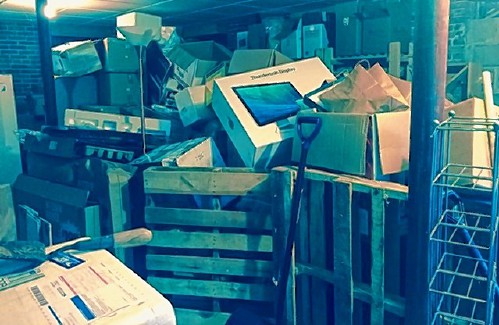
Do you need the help of an organizing professional...without the professional price? We asked Washington DC's organizing and de-cluttering guru Nicole Anzia of Neatnik for some words of organizing wisdom. Instead of giving us additional organizing and decluttering tips and strategies, Nicole though it would most helpful to tell us what NOT to do when trying to harness the chaos in your home.Nicole says these five missteps are the most common in her line of work — and most likely to derail even the best efforts to conquer clutter:

Organize First; Buy Second

Do not go out and buy a ton of storage pieces and supplies before you sort through your home. All of those pretty bins, boxes and baskets at The Container Store are very enticing, but they won't do you any good unless they fit the space (on the shelf, under the bed, in the closet); hold what you need them to hold, and function properly for your particular space.

I recommend cleaning out first, assessing what containers you REALLY need, and then buying a few bins to start. You can always add later, but you don't want a bunch of empty containers cluttering up your home while you figure out where you might use them.


Don't Bite Off More Than You Can Che

Do not set aside an ENTIRE day to organize your WHOLE house. Very few people have the energy and/or focus to spend 8 hours organizing. You'll likely become frustrated and less efficient as the day progresses. It's much better to spend a few hours — 2 or 3 — on one project or space. This way you'll feel motivated to do more, not be burned out by the process
(Image credit: Kim Lucian)

Complete Each Task — Completely

Of course you will need to sort things into categories (e.g., toss, recycle, donate, give to friend, put in deep storage). But here's the crucial part: Once you have decided where something is going to go — take it there. Never keep bags for charity or boxes for friends in your home to deliver later. Do it now. Finish the process. Take the bags and boxes out to the trash or recycling immediately. If you're donating something or giving something to a friend or family member, put the items in your car or make arrangements for dropping them off. You've done so much work getting this stuff ready to take out, complete the deal!

Rome Wasn't Built In A Day

Do not think that once you've organized your space, that you are done. You'll feel like a failure when you have to clean it up again in a month. Realize that while you have created a new, efficient, and logical system for processing and managing incoming and outgoing items, you are not done. There is no autopilot. You should expect regular upkeep, but just be glad that the new system is far more efficient than the old one.

Good Enough is Enough

Very few people have closets and drawers that resemble those in catalogues. Trust me. I've been in a lot of houses and apartments and even after we've totally reorganized a space, it doesn't look like an ad for The Container Store. It looks great and works properly, but it is a space that is used by an actual human being, not one that has been carefully staged by a team of stylists and marketers for a non-existent resident. You will ultimately be disappointed if perfection is your goal. The goal is to set up a space that works well for your needs. That is success.

- Re-edited from a post originally published 8.5.2014 - CM

The Must Have Organization Item for any Home

Over the years that we have been together, my husband and I have now renovated or created 4 kitchens. Two in New York, and two in Northampton. As people who both love to cook, we have come to understand what our kitchen "must have" list includes. This has changed and expanded with time and experience. For us, one small, but important detail in a kitchen is a magnetic knife rack. We love having access to our knife collection - without having to rifle through drawers. We also love our knives and like to display them. (#kitchengeek). I was excited to come across this article in Apartment Therapy yesterday, outlining some fantastic uses for this wonderful item. Who knew that our favorite kitchen secret had so many practical uses? 

11 Uses for Magnetic Knife Racks You're Probably Overlooking

48e39e4b77bc91890dad6e882ab3235b85d24bc1?auto=compress&w=240&h=240&fit=crop
Dabney Frake
May 17, 2018
 
(Image credit: Marie-Lyne Quirion)
 

I'm prepared to say that 85% of U.S. citizens have one of these magnetic knife holders hanging somewhere in their kitchen (that's a totally made up number btw), and the other 15% should get on board. And then 100% of us should look for other places to mount them in our homes, because these simple little strips are good for so much more than just knives. Here's a whole bunch of ways they make organizing easy.

 
(Image credit: Design Sponge)

Install a magnetic knife rack inside a big cabinet, as seen on Design Sponge. It's a great way to keep track of smaller items and reduce visual clutter.


(Image credit: Regina Yunghans)

Regina solved one of life's little annoying problems with one of these: Where and how to store food processor attachments. This is such a clever idea for keeping sharp blades safe and out of the way.

 
(Image credit: IKEA)

IKEA, no surprise, has a lot of clever ideas on how to use them. Mount a magnetic knife rack (or two) next to the door—either vertically or horizontally—to hold keys and other important reminders before you head out the door.


(Image credit: Amelia Lawrence)

Amelia created a version to display photographs, memos, and other important items. A store-bought strip would work just as nicely if you don't want to take the time to DIY.

 
(Image credit: Amazon)

Install a holder inside your bathroom drawers to keep all those little hair accessories and grooming supplies in one place and within reach. This one from Amazon isn't currently available, but there are other nice wooden options for under $30.


(Image credit: Local Kitchen Blog)

If you aren't using the underside of your kitchen cabinets, you're missing valuable storage real estate. Mount your knives upside down, as spotted over on Local Kitchen's blog, and the strip's slim profile takes up very little room and tucks out of sight.


(Image credit: Crate & Barrel Kids)

From Crate & Barrel Kids comes this storage-meets-art idea for hanging toy race cars. Not only does it give you a place to keep all those loose ankle-sprainers, but it makes for some very fun and dramatic decor.

(Image credit: IKEA)

After cleaning your paint brushes, IKEA suggests you squeeze the water from the bristles and attach them to the magnetic strip to dry. It's a great way to keep your counters clear and clutter-free. (Although, note that it's better to store paintbrushes upside down...)

 
(Image credit: Blu Kat Kraft)

Great under-the-cabinet idea: Put some magnets on the lids of your spice jars, then attach them to knife strips mounted there. These clear options let you see what you've got, so simply unscrew the jar when you need it.

(Image credit: The Cavender Diary)

Have a garage, or a spot to work on projects? Hang a couple of these racks for loose bits, screwdrivers and other tools. This amazing set up is courtesy of the Cavender Diary.

(Image credit: Armelle)

And here's the adult version. Armelle organized her closet and decked out the back of the door with all sorts of storage solutions, including a magnet for her scissors and punches.

Apartment Therapy supports our readers with carefully chosen product recommendations to improve life at home. You support us through our independently chosen links, many of which earn us a commission.
 

Ideas and Solutions for a Small Living Space

I was recently visiting with a friend who lives in a fairly typical for Northampton MA, late 1800's farmhouse. She is a master collector of curiosities, used-yet-hip furniture, artwork, tchotchkes, etc. She manages to pack a lot of stuff into her small home - and make it look artful, cozy and inviting. In addition, everything is functional! [...]

The Benefits of Adding Solar Power to Your Home

alt tag

In our development in Florence, MA, just 2.5 miles from downtown Northampton, MA, it seems that solar panels are going up on yet another neighbor's home on a weekly basis. We started the process of interviewing local solar providers last year, but had to put the project on hold for a variety of reasons. Now we are ready to open this can of worms once again. Luckily, our neighbors have done a lot of research, which they are happy to share. The following article from Apartment Therapy does a nice job of explaining the costs and benefits associated with installing solar panels on ones' home. The good news is that buyers do seem to be willing to pay more for solar power - so you needn't stay in your home long enough to see a direct return on investment. 

Can Solar Power Pay Off? One Homeowner Crunches Real Numbers

By Julie Sprankles 

Aside from the obvious benefit of helping the planet, solar power can be pretty enticing to homeowners who are tired of paying an arm and a leg for their electric bill every month. Given that outfitting a home with solar panels comes with considerable costs upfront, though, is doing so practical from a financial standpoint? Can solar power in fact pay off?

For starters, it's worth noting that the benefits—as well as costs—of installing solar (also called photovoltaic) power systems will vary from house to house. This makes sense, right? Your house might be much larger than my house. My house may be in an area where solar power is more readily available and therefore more affordable. The variables go on and on.

In general, however, there are a few universal benefits of installing solar power: it lowers your electric bill, minimizes your carbon footprint and, depending on where you live, it can even bump up your home value.

On the flip side, you'll need to drop a pretty penny upfront in order to buy the equipment and pay for the installation. The big question, of course, is whether the potential savings will outweigh those upfront expenditures—or, more pointedly, whether you'll actually be able to save money (or make money, if the value of your house goes up considerably) should you invest in solar power.

How much does solar power cost to install?

Let's talk numbers, shall we? A solar power system for an average-sized house in the U.S. can run anywhere from $15,000 to $40,000. If those figures give you a serious case of sticker shock, don't fret just yet—many companies allow you to "lease" the equipment, which dramatically reduces your upfront costs. But should you decide to purchase outright, you may qualify for government incentives that cut the cost of the system. In all 50 states, installing a solar power system qualifies the homeowner for the Residential Renewable Energy Tax Credit. This tax incentive allows you to claim a credit of 30 percent of qualified expenditures for your system and, most importantly, helps to shave down the time it would take for your savings to equal out or exceed your initial investment.

If you're the type that likes online calculators, you'll be particularly happy to learn that Google has come up with a handy little number-cruncher to give you an approximation of the costs and savings you can expect with solar in your own home. Called Project Sunroof, the tool relies on high-resolution aerial mapping to calculate your specific roof's solar energy potential. According to Google engineer Carl Elkin, the site "figures out how much sunlight hits your rooftop through the year, taking into account factors like roof orientation, shade from trees and nearby buildings, and local weather patterns."

Technology... crazy, huh?

When I plug my home's address into Project Sunroof, it spits out an aerial thermal image of my street that is, if we're being honest, pretty damn impressive in its detail. The fact that my roof is glowing bright yellow clues me into the fact that sunlight is aplenty, but the site spells it out for me, too.

By their estimate, my roof receives 1,606 hours of usable sunlight per year. Based on 3D modeling of my roof and nearby trees, the site figures I have 564 square feet of roof available to be outfitted with solar panels—and they recommend an 8-kilowatt system, which would cover 40 percent of our household electricity usage.

What does all of this mean for my bottom line and, theoretically, yours? That, yes, a solar power system can pay off.

With the system covering around 40 percent of my household electricity usage, my 20-year benefits of utilizing the system would total $37,000. If the upfront cost of a system after tax incentives amounts to $17,000 and we deduct that from the benefits, the 20-year savings comes out to $20,000. In other words, it would take nine years to pay back that initial investment.

You may be thinking, "Yeah, but this only pays off if I actually stay in the home for nine years." In which case you may be relieved to learn that research conducted by the Department of Energy in 2015 showed that buyers are happy to pay more for homes with solar power systems.

The study, which was cited by The New York Times, revealed that buyers were willing to pay a premium of $15,000 for a home with a solar power system, compared to a similar home without one. The only caveat is that these findings apply to systems that are owned, not leased.

So although there's no hard-and-fast rule for whether or not solar power systems will pay off in every unique situation, they can certainly save you money immediately on your electrical bill whether you buy or lease. And if you have the capital to make the full investment upfront, you could be looking at paying off the system in less than a decade and enjoying sizable savings and a big ROI in the long-term.
Winter Projects for Homeowners

Quick, Not Dirty

This time of year, many of us find ourselves homebound on our days off (some of us choose to be homebound on our days off :)). Winter is a great time to attack our indoor homeowner to do list - since we certainly can't do any landscaping in the cold, wet, windy winter months of the Pioneer Valley. This recent article by Jolie Kerr makes great suggestions for indoor cleaning/organizing projects, best done when you don't feel like being [...]

1-10 of 22 Posts